
I’m an Enneagram 8. I have this annoying tendency to struggle to admit I’m wrong. I have an equally annoying tendency to want to prove to you that I’m right. Intentional or not, I can be dismissive of your opinions.
One of the things I’ve been working on in this season is trying hard to avoid my natural inclinations in this regard, especially when it comes to politics.
I first got the idea for today’s topic several days ago. But after yesterday’s killing of Alex Jeffrey Pretti by federal agents in Minneapolis, I wasn’t sure I could stick with what I had originally wanted to write about. There was and is a lot of felt pain by myself and others that’s still raw.
But I ultimately decided yesterday’s events require me to speak up all the more. Forces are at work that are tearing away the fabric of our society and our innate ability to see the humanity in others. You already know the list: algorithmic filter bubbles, partisan news, a media economy where outrage drives profits and nuance doesn’t.
Today’s piece is a call to find the humanity in “the other.” This American experiment won’t last if we give in to the forces that desire to keep us divided.
Permission to Be Complicated
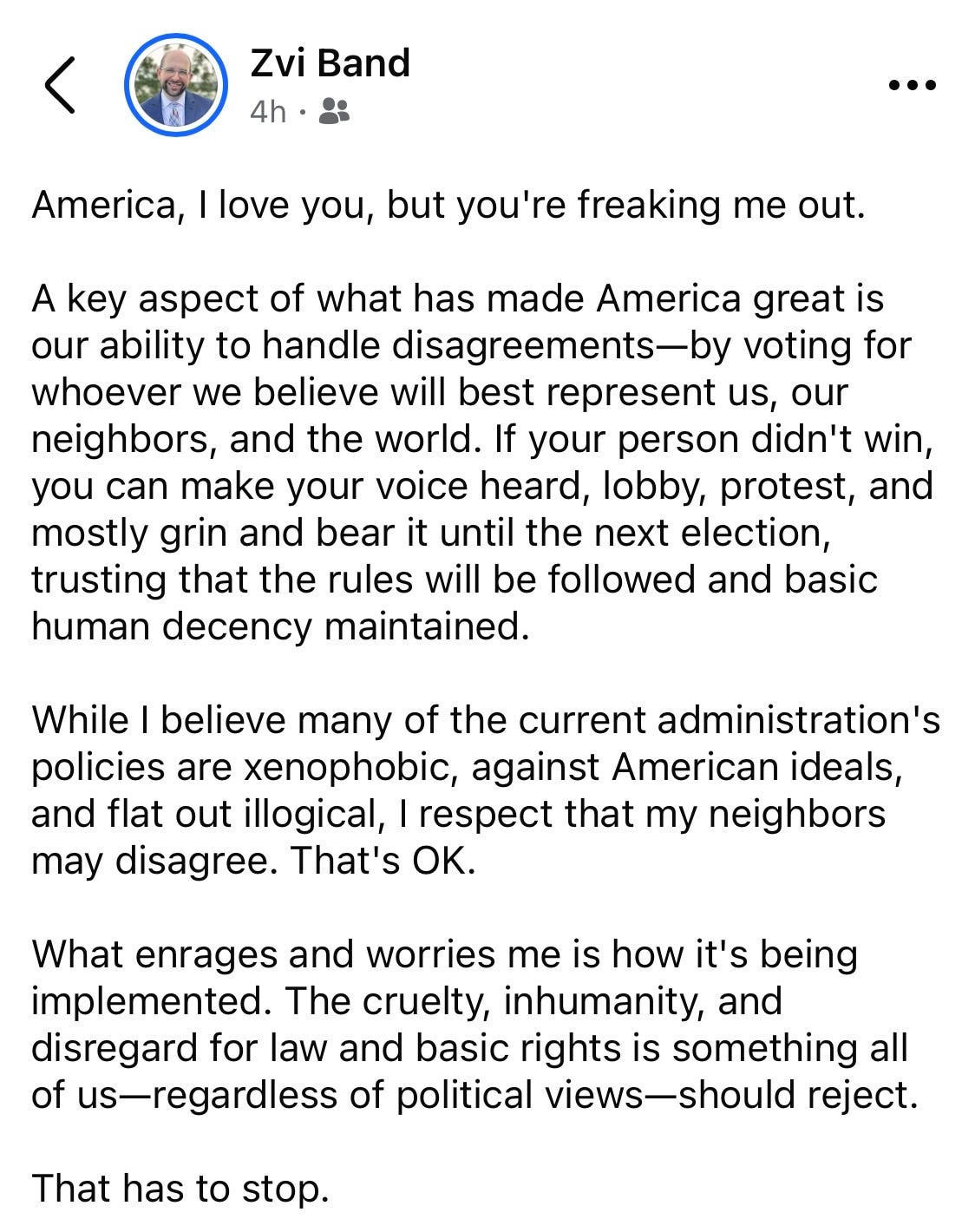
Two of my friends, Scott Burns and Zvi Band, posted things on Facebook this week that I think need to be shared more broadly. Both are making a similar point: you can hold your values and still call out what’s wrong.
Zvi wrote:
Scott wrote:
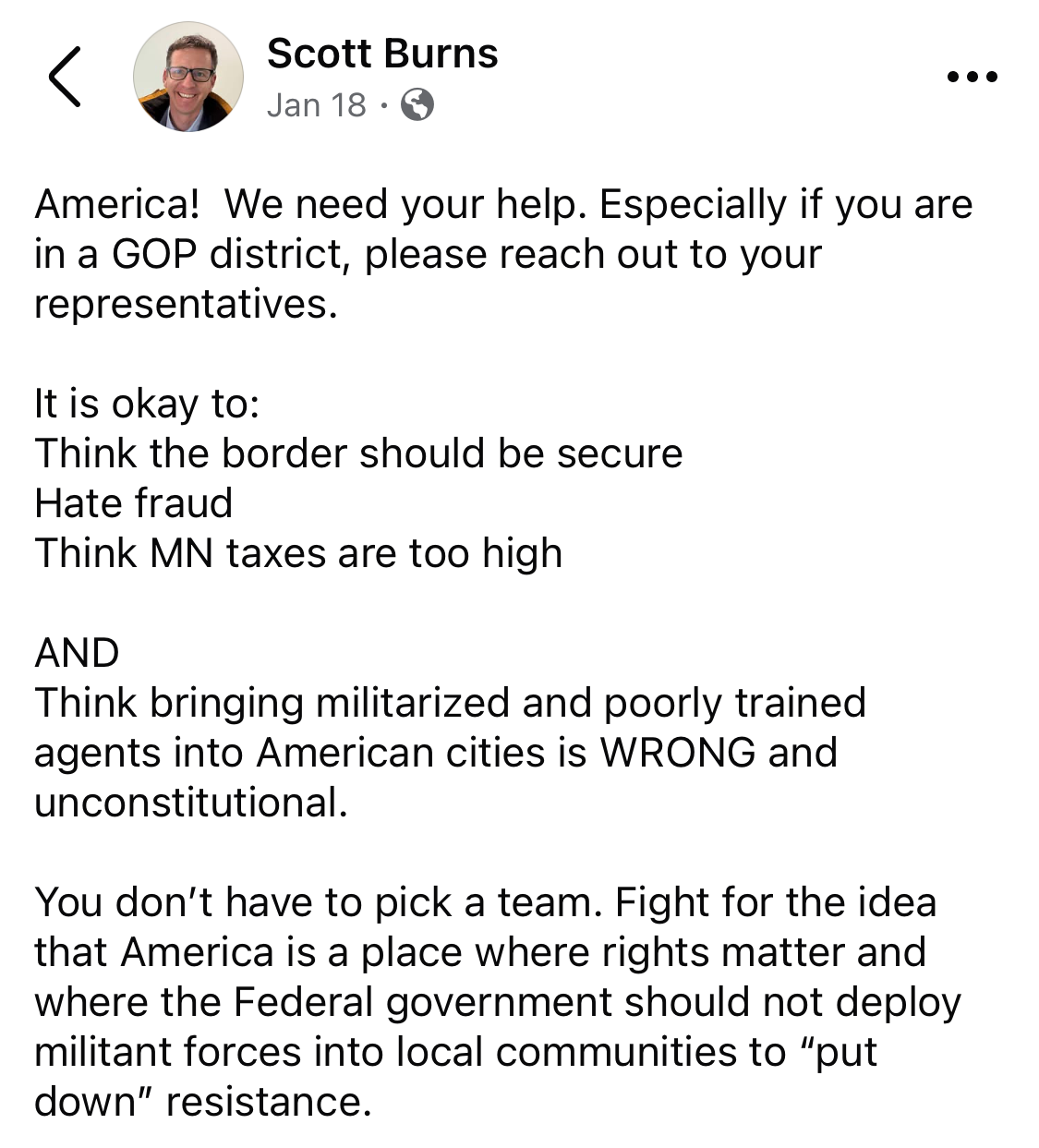
What strikes me about both posts is that they’re giving people permission to be complicated. You don’t have to pick a team and defend everything that team does.
I want to offer the same permission from the other direction. I’m a centrist who nearly always votes for the left side of the ticket. And yet, as an entrepreneur at heart, I couldn’t disagree more with the most leftist policies that paint every aspect of capitalism as bad.
I think some of the “purity tests” on the left are a big reason Democrats lose elections. Continually shaming people for using the wrong combination of words, or for not agreeing on one position, isn’t a winning strategy. Not recognizing good faith efforts from allies can poison the well toward progress.
Your identity isn’t your political party. You’re allowed to be a whole person with nuanced views. Two things can be true at once.
This Week Has Been Hard
It’s easy to lose hope in the midst of Alex Jeffrey Pretti being killed in the streets by federal agents. It’s easy to lose hope seeing 5-year-old Liam Conejo Ramos seemingly used as bait and taken into custody and shipped to Texas. It’s easy to let your heart fill with disdain and let the accusations start flying.
If you’re angry right now, that anger is legitimate. If you’re grieving, that grief is warranted. I’m not here to tell you to calm down or move on.
And yet. We still have to figure out how to live together. We still have neighbors, coworkers, and family members who see things differently. The question isn’t whether to feel the weight of this moment. It’s whether we let it permanently sever the relationships that make community possible.
When we respond to injustice with contempt for everyone who doesn’t immediately see it our way, we lose potential allies along the way. People who might be persuadable get pushed back into their corners when they feel attacked rather than invited. The cause suffers when the tent shrinks.
How We Live Indivisibly
There’s ancient wisdom that says we should be “quick to listen, slow to speak, slow to anger.” I’ve been trying to take that seriously.
I have friends and family who disagree with me politically. On candidates. On specific issues. I’m not perfect at this. I still feel my Enneagram 8 instincts kick in, wanting to prove I’m right. But I’m making an effort because I know many of these people are genuinely kindhearted. They want to do the right thing. They’re not cartoon villains. And I’m not willing to flippantly throw aside those relationships.
So here’s what I’m trying to practice: not talking back immediately, but actually listening before formulating my response. Not being dismissive of the first thing I hear, because the opening statement might not represent someone’s full view.
Acknowledging good faith efforts matters. I saw someone post screenshots of their texts with their mom this week. His mom had proactively reached out, heartbroken, saying she was praying for him and for Minneapolis. The son’s response was immediate: “I don’t need your prayers,” followed by a list of calls to action. I understand the impulse. But I wonder what would have happened if the conversation had started with “thank you for thinking of me” and then, later, “would you also consider calling your representative?”
Avoid purity tests. Not everyone who disagrees on one issue is your enemy on all issues. Have real conversations, in person or on the phone. Use text only if you can avoid an accusatory tone. Don’t have your most important conversations on social media. The person on the other side becomes an avatar instead of a neighbor.
Avoid inflammatory language. Read the room. Don’t choose this particular week to compare your conservative hero to MLK, Jr. with your progressive friend. Avoid using words like “on both sides” in response.
Start from shared humanity, not opposing positions. Seek common sense solutions together. Most people want safety for their families, opportunity, and to be treated with dignity. Start there.
Of course, there are trolls online and there may be people in your life truly operating in bad faith. Don’t waste your energy on those situations.
What I’m Trying to Unlearn
“2016 Aaron” would have moved pretty quickly to tell you why you voted wrong and blamed you for why we are where we are. I was righteous. I was certain. I was insufferable.
Today, I try harder to seek awareness, understanding, and alignment on individual positions rather than accusatorially focusing on the past. I don’t always succeed. But I’m trying.
I’m not asking you to abandon your convictions. I’m not asking you to stop calling out injustice. I’m certainly not asking you to pretend everything is fine when it isn’t. I’m asking you to consider:
How can you seek to see the humanity in “the other” today, whether “the other” is the protestor, the immigrant, or that friend or family member who votes differently than you do?
What positions of “orthodoxy” are held by your political team that might need to be revisited?
How can you approach those with differing views with a posture of listening instead of an accusatory, I’m-right kind of tone?
How can you step away from your own filter bubbles and find additional perspectives?
One nation. Indivisible.
That’s what we say. I’d like to believe we still mean it.
2026 Aaron exudes growth. Thank you for this measured response.
I’ve been thinking a lot about you and your family this past week and how hard it must be for you. I’m praying for you.